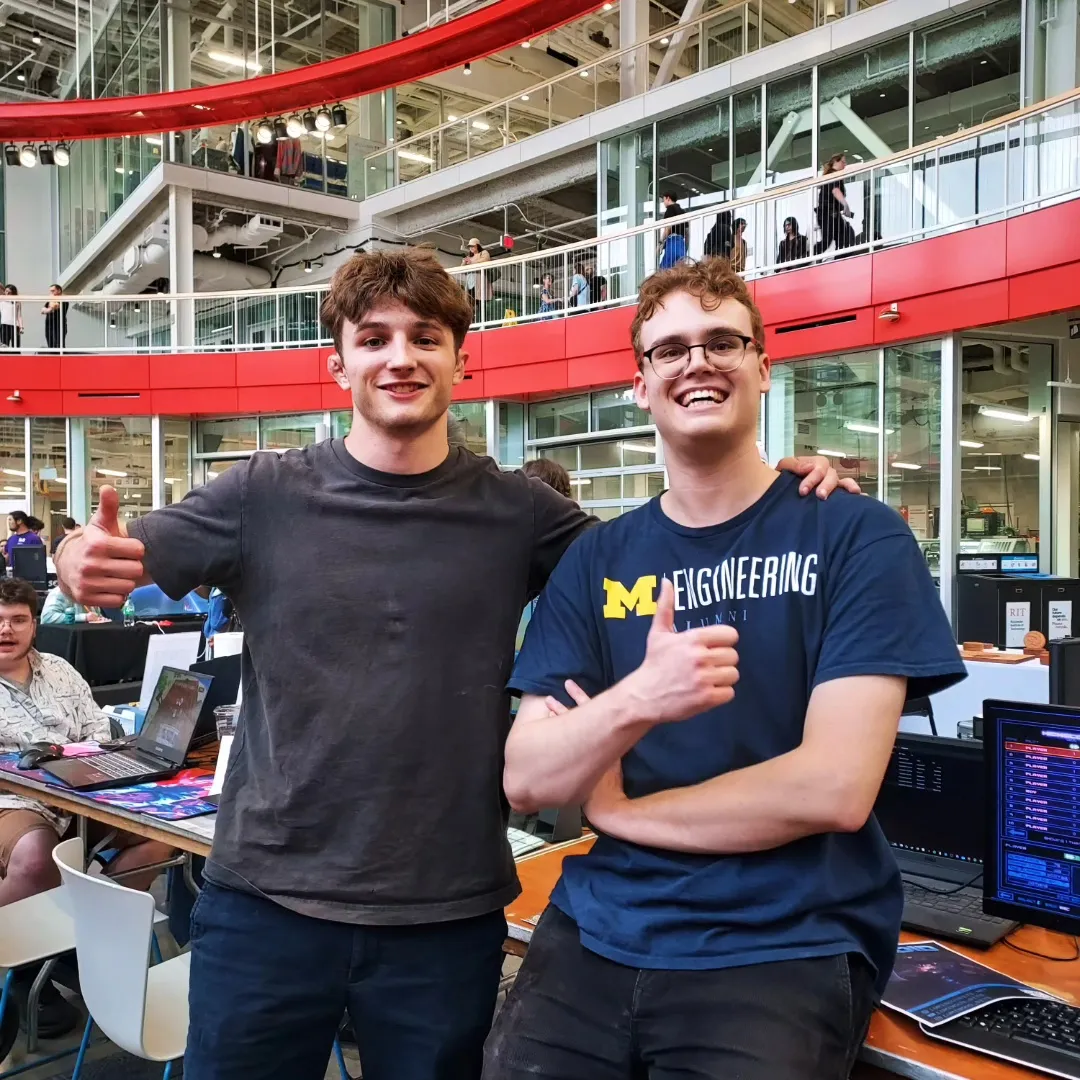
Hello, I’m Charles Dill. I work out of (and for) The Valley and about a year ago I founded Luminous Bits, an indie gaming studio developing Devoid, a sci-fi twin-stick shooter that takes you through a treacherous region of space.
Having The Valley as a resource to build my game company has made a world of a difference. I previously worked out of my garage which wasn’t too bad. That said, sitting on a wooden chair for hours, having a space heater on my desk to keep my hands functioning in the colder months, and constant bugs (not software ones) flooding to the light of my monitor was far from ideal. One of my favorite things about The Valley is its amazing community. The ability to spin my computer around to ask for feedback and converse with others is something you can’t get working alone. In rural America it’s easy to get extremely isolated, even more so when taking on an ambitious venture.
And alone I was for quite some time. Until I connected with Jakub Mikolajczak. A fantastic programmer from NYC. After some time working together, we decided to join forces, making up the two co-founders of Cambridge based software startup Luminous Bits.
After developing the game for a few months, we felt confident we had something we could bring to a game expo. Which is one of the best places to get feedback because unlike online, at an in person event you can watch gamers play in person and see their genuine reactions. Which provides us as developers with significant value.
As for our first showing of Devoid, we weren’t even expecting to hit a game expo this Fall as our initial choice, 1Upstate was taken off the calendar a month out. So we figured that we would probably have to wait until the Spring. But being optimistic, we still reached out to ROC Game Fest (weeks past their deadline) to see if they had any tables left. They didn’t. And we were waitlisted. But with only two weeks to go, we got a text: “We had a cancellation for ROC, and if you’d like the table, it’s yours.” Just like that, we were in. Now that’s destiny!
Excitement was growing in the days leading up. On the morning of the event, Jakub and I set up our table, hardware ready, and waited patiently. The first player walked up, asked for a controller, and jumped in. We stood back and watched closely. Tutorial cleared. Main game started. Then… a second run. Not bad for the first playthrough of the day.
Throughout the event our booth stayed busy. People dropped in, played for solid stretches, and moved on. But what was cool to see is that later in the day, people started coming back. Not just to chat, but to play again. That’s the signal you want as a developer. It means the game isn’t just playable, it’s catchy. Fun enough to pull people back in.
Towards the end of the event, one player stayed at our booth for nearly an hour. He swapped spots with a few spectators to let others have a go, but his mission was clear: beat the final boss. He might’ve kept going if ROC hadn’t started shutting down for the day.
We left the event excited. Not only from the positive responses, but from all the great feedback too. For example one big thing that stood out to me as a graphics person is that environmental lighting isn’t always the same. Devoid pops in a dark room because of how moody and atmospheric the graphics are. But a bright university hall? Harder to see. A brightness slider is now on the list of features to add.
I’d like to give a huge thanks to the ROC team for putting together such a fantastic event and to The Valley for giving me a place to thrive. Ultimately we left with feedback, momentum, and most importantly Jakub and I were finally able to meet each other in person for the first time.
Curious about the event? Visit: rocgamefest.com
-Charles at The Valley