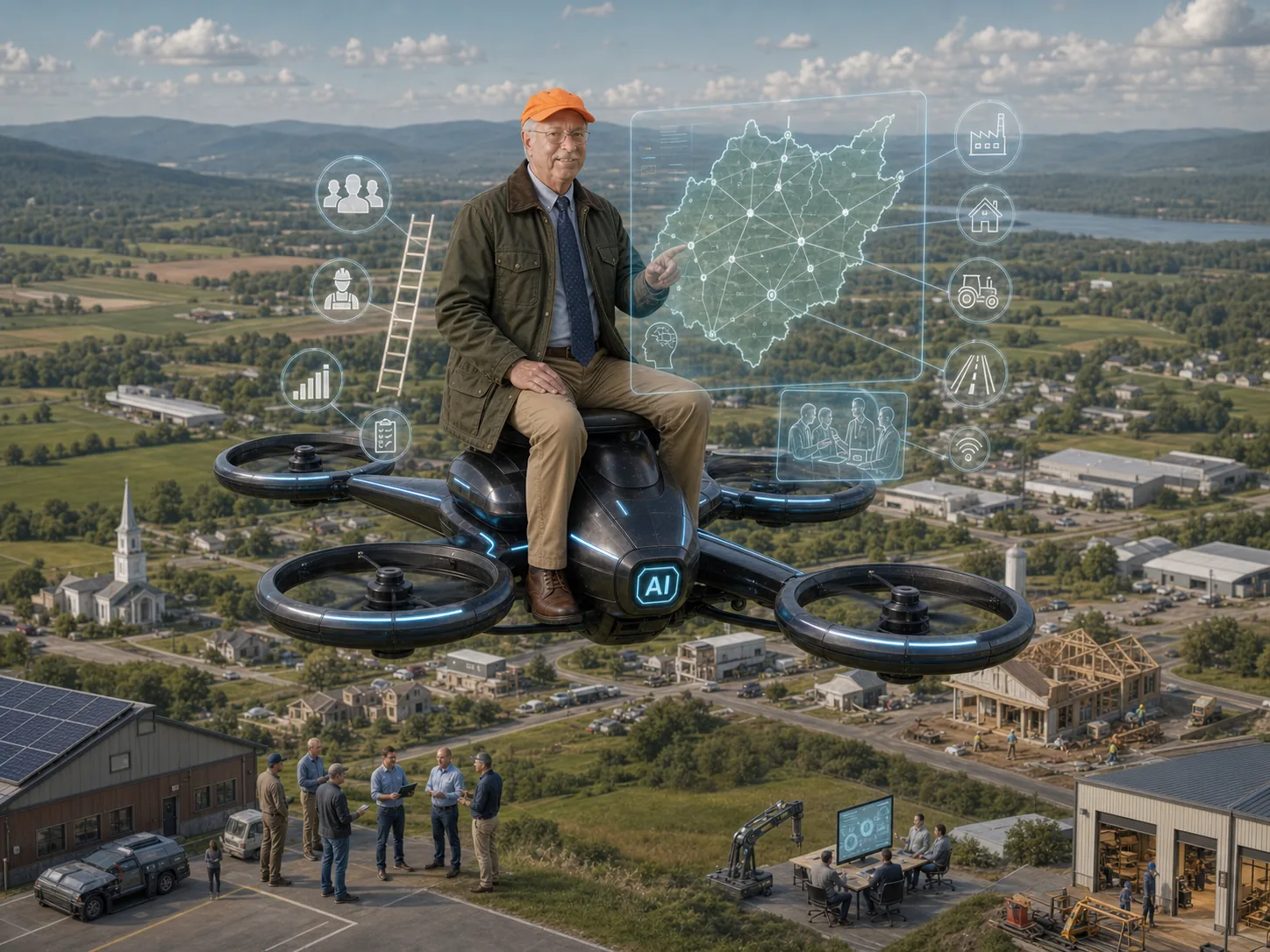
For decades, the familiar economic-development deal was built around a physical project.
A company needed land, a building, machinery, utilities, or an expansion. The public sector helped make the numbers work through a loan, a bond, a tax exemption, or a payment-in-lieu-of-taxes agreement. In return, the company promised jobs and a larger tax base.
That model made sense when industrial projects were large, fixed in place, and difficult to finance. Traditional lenders were less flexible, and reducing the cost of a building or a piece of equipment could unlock an investment that otherwise would not happen.
Those tools still matter. Infrastructure remains the best-organized part of economic development. But private finance is more flexible than it was, and a building does not run itself. The harder constraint is often whether a company can find, develop, and retain the people who understand the work.
A modern project should begin with a clear business model, then connect three investments: infrastructure, skills, and housing. If we do not understand how the business creates value, we cannot know which capabilities or roles it needs. If we do not know the roles, wages, and recruiting gap, we cannot know which housing to build or what workers can afford.
This is a workforce-centered view of industrial development. It does not reject finance or incentives. It organizes them around the people and capabilities that make an investment viable.
The Old System Organizes Infrastructure Well
Washington County already has a coherent set of tools and partners for physical investment.
Washington County's financing guidance describes conventional bank financing as generally the quickest and most convenient route for a commercial or industrial project. It also notes that the Washington County Local Development Corporation works with area financial institutions, sometimes participates jointly in projects, and gives local businesses access to New York Business Development Corporation products.
The LDC operates four revolving-loan programs. Two historically focus on manufacturing facilities, one assists small businesses, and another supports ventures that enhance the community. The terms are flexible, and the programs emphasize job creation.
Industrial Development Agencies add another established layer. The Warren-Washington Counties Industrial Development Agency can facilitate PILOT agreements, provide sales-tax and mortgage-recording-tax exemptions, and support tax-exempt financing for eligible projects.
This is useful infrastructure. A company, lender, developer, LDC, and IDA can discuss a site, a building, equipment, project cost, financing, and tax benefits in a common language. The responsibilities are recognizable, and the available incentives are relatively well organized.
The problem is not that we invest too much attention in infrastructure. It is that the next two rungs are disconnected from it.
A Business Plan Is the Wrong Working Document
A conventional business plan may still be required for a loan or grant. But it is the wrong working document for an early expansion conversation. It is long, relatively static, and usually written to present a settled story to an underwriter. Important assumptions can be buried across sections without ever being tested together.
A Lean Canvas is a better starting point. It puts the business model on one page and makes uncertainty visible. The standard canvas has nine parts: the customer problem, customer segments, unique value proposition, solution, channels, revenue streams, cost structure, key metrics, and unfair advantage.
Deeper understanding does not mean longer documents. Often it means the opposite. A one-page canvas forces a company and its partners to state what must be true for the project to work.
Once the canvas is credible, the project team can map what it takes to deliver the model: the operating process, intellectual property, AI exposure, equipment, roles, proficiency levels, wages, recruiting needs, and housing implications. Keeping those questions downstream preserves the discipline of the Lean Canvas while connecting the business model to real execution.
The point is not to eliminate the formal business plan. It is to change when it is written and what sits underneath it. The canvas becomes the living record of the model. The business plan can then document a model that has been understood instead of substituting paperwork for understanding.
Skill Investment Is the Missing Middle
Employers usually describe workforce problems in plain language. They cannot find people with a specific skill. New hires leave before they become productive. A second shift is impossible to staff. Experienced supervisors are retiring. Child care does not line up with work schedules. Transportation works only if every employee owns a reliable car.
Yet an expansion conversation often stops at a promised job count. It does not develop the role-specific understanding needed to turn those jobs into a skill investment plan.
The Lean Canvas explains why the business should work. The next step is to map how the company will deliver that value: what it knows, what it makes, which tasks create the advantage, and what must be protected or transferred as the company grows. From there, the project can identify the roles, tools, proficiency levels, schedules, starting wages, and advancement paths the expansion requires.
That work reveals two different gaps:
- Upskilling: Which current workers or local residents could fill the roles with paid training, credentials, mentoring, or a clearer path into the company?
- Labor-pool growth: Which roles are unlikely to be filled from the current pool and require the company and community to attract new workers?
Upskilling helps local people enter and advance. Recruitment expands the pool. A credible project needs to estimate how much demand can be met through each path.
Washington County's 2025-2030 Community Health Assessment reports a civilian workforce of 29,998 and an unemployment rate of 3.2 percent. That does not prove every employer has a labor shortage. It does show why announcing more jobs can miss the operating problem: many employers are competing for the same finite pool of people.
Workforce and education programs should therefore be designed as part of the project, with owners, costs, dates, and measurable outcomes, rather than offered as separate referrals after the physical deal is assembled.
Training Must Be Tied to Roles That Exist Here
A workforce-centered system cannot use "in demand" as a permanent label attached to a course. It has to show which employers need the role, which tasks it includes, what the job pays, how AI changes the work, and whether graduates are hired and retained.
SUNY Reconnect at SUNY Adirondack is a better test of that principle than a short list of noncredit courses. It covers tuition, mandatory fees, books, and supplies for eligible New Yorkers ages 25 to 55 who do not already have a college degree and enroll in an approved associate-degree program. The local list includes business analytics, computer science, cybersecurity, engineering, environmental science, health sciences, construction management, mechatronics, nursing, education, and substance-use services.
The program is highly relevant to the age of AI, but not because every degree leads to an "AI job." Its value is that the degrees sit in three different relationships to the technology:
- Building and operating AI-enabled systems. Applied Business Information and Analytics explicitly includes AI, data analytics, information systems, and digital communication. Computer science, cybersecurity and networking, engineering science, and mechatronics build the software, security, controls, robotics, and systems knowledge that employers need to adopt automation responsibly.
- Using AI inside human-centered work. Nursing, health sciences, substance-use services, and education will use more decision support, documentation, scheduling, and analysis tools. Their core value still depends on judgment, trust, communication, physical presence, and accountability. Curricula should teach workers when to use an automated recommendation and when to challenge it.
- Applying AI to physical systems and place. Environmental science and construction management can use AI for modeling, inspection, estimating, scheduling, and risk detection, but the work still depends on field knowledge, regulation, materials, safety, and local conditions.
None of those degree paths is made irrelevant by AI. The more immediate risk is that a program keeps a durable title while the tools and entry-level tasks underneath it change. The opportunity is to update coursework around real workflows, pair degrees with paid local experience, and make the next role visible.
SUNY Reconnect is therefore a strong financing tool for skill investment, but "high demand" is a statewide eligibility label, not proof of a Washington County pathway. The county still needs to connect each degree to named local employers, specific roles, wages, paid placements, and advancement. Otherwise the public may finance a useful education without building the local capability the industrial strategy needs.
The same discipline should apply to WSWHE BOCES. Its 2026 CTE offerings include Industrial and Performance Machining, Welding, HVAC-R, Health Occupations, Heavy Equipment Maintenance and Operation, and other programs that fit the region's economic base. There are real employer connections. Cambridge Valley Machining's openings include CNC machining and maintenance roles. Fort Miller Group says it works with multiple BOCES locations, hosts more than 400 students and educators annually, and offers exposure to more than 140 roles.
Those connections also reveal an employer-capacity problem. A serious partnership asks an employer to assign mentors, coordinate with instructors, host students, supervise work-based learning, expose real equipment and processes, and keep the curriculum current. That burden tilts the system toward employers large enough to carry dedicated HR or training staff. Most smaller firms cannot function as an unpaid training department, even when they urgently need talent.
Scale does not solve the harder discovery problem. A partnership with a college, even an institution such as RPI, can still underperform if it begins with a program or credential instead of the company's next operating capability and exact task needs. An advanced-sounding curriculum is not an advanced-economy strategy when nobody has defined what the company is trying to make next.
This gives the public intermediary two jobs: lower the participation burden for smaller firms by sharing coordination, mentors, equipment, and curriculum support; and lead the role-mapping work before asking a school or college to build a program. The school should deliver the training. It should not have to guess the business strategy.
BOCES, SUNY Adirondack, the workforce system, and employers should refresh the role map every year, publish it, and fund pathways backward from jobs that actually exist. AI makes that cycle more important because a role can keep the same title while the work inside it changes.
The County Line Is Not the Labor Market
Washington County does not have to build every institution it needs. But it does need to understand the geography of each partnership and protect a clear local interest inside regional systems.
The county has pooled much of its education and workforce infrastructure with Warren and Saratoga counties. Washington and Warren are the sponsoring counties of SUNY Adirondack, whose main campus is in Queensbury and whose Saratoga center is in Wilton. WSWHE BOCES serves five counties. Its Vision 2027 project will consolidate programs now offered in Saratoga Springs, Hudson Falls, and Glens Falls at a new campus in Wilton.
That regional scale can create better programs and equipment. It can also put more distance between a Washington County employer and the people designing the program. The county's own minutes show that this is not an abstract concern.
In March 2025, the Economic Development Director told supervisors that the workforce system had a gap in employer relationships and employer-provided programs. The county was trying to build an accurate employer list, improve outreach, and establish useful performance measures. In June, supervisors required more employer visits and quarterly outreach reporting from LEAP. They also chose a Washington County resident for a regional workforce-board seat, noting that Saratoga then had 13 appointments, Warren 10, and Washington seven.
The regional map is already beginning to turn east. In January 2026, after a BOCES representative shifted to a Saratoga County seat, Washington County recommended Easton resident Jonathan Ashdown, an executive at Hudson Valley Community College and an RPI alumnus, as its replacement. That appointment creates a practical bridge to Rensselaer County's advanced-manufacturing and technical-education assets. RPI's new Center for Smart Convergent Manufacturing Systems, for example, is built around robotics, AI, advanced processing, and industry projects.
The opportunity is a reciprocal corridor. Washington County employers and residents should gain structured access to Rensselaer County's colleges, labs, applied projects, and advanced-industry networks. In the other direction, parts of southern Washington County could contribute to the broader Capital Region's housing supply, while giving residents access to employment and education on both sides of the county line.
This distinction matters as the Saratoga-Warren-Washington Workforce Development Board considers consolidation with the larger Capital District system. In May 2026, supervisors asked whether consolidation would reduce local centers or services, whether Washington County's influence would be diluted, and what the success rate, retention rate, and cost per participant actually were. Those are the right questions. Regional scale should lower overhead and expand capability without making local employers and workers harder to see.
Housing Investment Follows the Labor Gap
Once a project knows which roles can be filled through upskilling and which require labor-pool growth, it can ask the housing question with useful specificity.
New workers and families need homes they can find and afford at the wages the jobs pay. Workforce housing is not a special category reserved for factory employees. It is the ordinary mix of rentals and ownership opportunities needed by machinists, teachers, health aides, service workers, young families, and new residents.
Washington County's housing problem is not the same in every part of the county, and it is not automatically the same as the North Country's. County minutes from 2024 and 2025 describe an immediate preservation problem: old and severely degraded homes, expensive lead and asbestos work, accessibility needs for older residents, long waiting lists, and a shortage of contractors. That is different from a market driven primarily by seasonal homes or short-term rentals.
North Country Rural Development Coalition brings useful operating capacity. It has already administered rehabilitation work in Washington County and will partner with the county to operate the new land bank. In February 2026, the Board of Supervisors accepted a $700,000 Community Development Block Grant housing award to be executed through NRDC. Sharing an experienced operator does not mean importing another region's housing diagnosis. Washington County still needs to decide which properties, households, price points, and communities each program should serve.
That suggests at least two housing tracks. The first is preservation: repair occupied homes, replace unsafe manufactured housing, return vacant properties to use, and make older homes safe for residents who want to remain. The second is workforce growth: add rentals, starter homes, and infill where employers or regional labor corridors create demand.
In southern Washington County, that second track could include a deliberate partnership with Rensselaer County and the broader Capital Region. New housing there may serve people who work or study across the county line as well as employees of Washington County businesses. A reciprocal agreement could connect housing production with transportation, broadband, technical education, and access to employers in both directions.
The Sequence Is the Strategy
The work should move in this order:
- Define the business model. Complete the Lean Canvas, then map the intellectual property, operating process, expansion goal, and AI exposure behind it.
- Define the infrastructure need. Identify the site, utilities, building, machinery, technology, and capital required to deliver that model.
- Translate the plan into role-specific demand. Name the occupations, tasks, proficiency levels, schedules, wages, and advancement paths the project requires.
- Backfill the skill gap. Determine what can be met through upskilling, retention, work redesign, and local recruiting, then quantify the roles that still require labor-pool growth.
- Backfill the housing gap. Convert the remaining recruiting need into households, affordability ranges, and locations, then line up rehabilitation, infill, new construction, approvals, and partners on the same timeline as the business project.
The order matters. Housing investment without role and wage data is guesswork. Training without role-level demand can produce credentials that do not connect to a job. Infrastructure without either plan can produce a building that a company cannot staff.
The Ladder Is How a Rural Economy Moves Upstream
The ladder is not only a way to fill today's openings. It is how a rural economy moves into higher-value work.
The choice is not between blue-collar work and an advanced economy. Skilled production, maintenance, construction, machining, farming, and care are the foundation of an advanced economy. The risk is that rural communities remain at the lowest-margin end of someone else's value chain while design, intellectual property, process engineering, customer knowledge, and profits accumulate somewhere else.
A community does not move upstream by announcing that it wants more technology jobs. It moves by understanding the work already happening here and deliberately building the next adjacent capability.
That progression can be concrete. A machine operator can become a setup technician, CNC programmer, metrology specialist, process engineer, and eventually part of a prototype or product-development team. A production worker in paper, filtration, concrete, or advanced materials can move into controls, instrumentation, testing, process improvement, and product development.
Washington County already has examples of this progression:
Fort Miller Precast combines hands-on production with in-house engineering, automated equipment, a quality-control laboratory, proprietary infrastructure systems, patents, and employee ownership. Production is connected to engineering, testing, intellectual property, and ownership.
Cambridge Valley Machining spans CNC machining, 5-axis capability, robotic polishing, and design-through-manufacturing for aerospace and defense customers. The workforce task is to help local people move from operating equipment to programming, inspecting, improving, designing, and leading the process.
Adirondack Studios in Argyle connects carpentry, metal and composites fabrication, scenic art, electrical and automation systems, design, project management, and installation to projects delivered around the world. It shows how hands-on trades connect directly to creative work, technical design, customer delivery, and global markets.
Saint-Gobain's Granville operation shows the ladder inside one advanced-materials plant. A coater operator works with films, adhesives, laminating, winding, and quality inspection. A process engineer applies polymer and product knowledge to coating, lamination, web handling, extrusion, mixing, equipment design, quality, and continuous improvement.
These examples point to the same policy task: make the next rung visible, attach training to it, and measure whether local workers can advance into it. A project that creates fewer but better jobs while building a transferable local capability may be more valuable than one that adds more low-wage positions with no path forward.
AI Makes the Ladder More Important
AI is not a separate rung. It changes the assumptions inside every rung.
The U.S. Bureau of Labor Statistics expects generative AI to affect occupations differently according to how readily their core tasks can be replicated, while noting that the employment path for many exposed occupations remains uncertain. That makes a top-line job count an especially weak starting point. Before estimating skill demand or housing need, a project should run an AI stress test at the task level.
That stress test should ask:
- Which tasks will AI or automation replace, augment, or create?
- Which parts of the company's intellectual property, proprietary data, operating knowledge, and customer relationships become more valuable?
- What connectivity, sensors, software, data architecture, cybersecurity, and governance now belong in the infrastructure plan?
- Which workers need paid, workflow-specific training, and which supervisors must redesign work rather than simply buy a tool?
- How do the changes affect role counts, entry-level pathways, wages, schedules, productivity, and recruiting?
Generic AI literacy is not enough. A machinist, nurse, bookkeeper, and wastewater operator do not need the same training. In some roles, AI may remove routine tasks and raise the value of judgment, troubleshooting, communication, and process knowledge. In others, it may reduce hiring demand or create a new technical role.
That uncertainty is already visible in employer behavior. In the New York State Department of Labor's 2024 workforce survey, 28 percent of businesses were unsure whether they would implement AI in the next 12 to 24 months, and 39 percent were unsure whether AI would reduce current staffing or future hiring.
AI also exposes the limit of a headcount-only public scorecard. A project may produce more output with fewer added positions, but stronger wages, safer work, better retention, and new advancement paths. Public incentives should require the company to explain the worker impact and define a public return in skills, earnings, access, retained capacity, and measurable business growth.
The Washington County LDC Can Help Lead the Update
The LDC is well positioned because it is local, flexible, and already described as a single point of contact for business development. It can make the full project sequence part of every serious expansion conversation.
A modern LDC review could ask:
- Does the Lean Canvas show a credible problem, customer, advantage, cost structure, and revenue model?
- What operating capability and intellectual property drive the expansion?
- Which physical and digital investments are required, and how will AI change the work?
- Which roles, tasks, wages, schedules, and advancement paths does the project require?
- What can be met through upskilling and local recruiting, and which roles require the labor pool to grow?
- Can the existing housing supply accommodate the households the project needs to attract?
Where program rules allow, loan proceeds or paired funding could support paid training, onboarding, process redesign, or equipment that makes a role more productive. Where they do not, the LDC can still require a credible skill and housing analysis and connect the employer to the right funding and delivery partners.
The county already identifies a network that includes BOCES, SUNY Adirondack, LEAP, the regional workforce system, the Small Business Development Center, and other finance and business-assistance organizations. The land bank and North Country Rural Development Coalition add housing capacity. The opportunity is to organize those partners around one project sequence instead of handing the employer a list of referrals.
IDAs Still Matter. Their Scorecard Should Evolve.
This is not an argument to abolish IDAs or weaken traditional incentives. It is an argument to stop treating a financed facility and a promised job count as the complete definition of economic development.
New York has already moved toward stronger accountability. The State Comptroller notes that reforms enacted in 2015 require IDAs to assess project progress annually and maintain policies for discontinuing or recovering assistance when commitments materially fall short.
The next step is to improve the commitments themselves. An IDA application should still describe project cost, private investment, tax benefits, and expected jobs. It should also explain:
- The occupations, wages, schedules, benefits, and advancement paths attached to the project.
- The difference between new jobs, retained jobs, and positions that are routinely vacant.
- The AI and automation assumptions behind the role count and their effects on tasks, entry paths, wages, and productivity.
- The share of demand expected to be met through upskilling, local recruitment, and recruitment from outside the current labor pool.
- The training contribution, transportation realities, housing price points, and milestones for hiring, retention, skill progression, and wage growth.
No IDA needs to run those programs itself. But it can evaluate whether the operating model is plausible, connect incentives to measurable commitments, and review outcomes with more precision than a single promised headcount.
What a Modern Development Deal Looks Like
Imagine a Washington County manufacturer planning an expansion expected to create 25 jobs.
The traditional deal begins with the site, utilities, construction budget, machinery, financing package, and available tax benefits. The updated deal keeps all of that, but places it inside a fuller sequence.
The company first completes a Lean Canvas so the commercial logic is visible. It then maps the operating process and intellectual property behind the expansion, tests which tasks AI or automation could replace, augment, or create, and translates the revised plan into specific roles. The original estimate of 25 jobs may hold, rise, or fall, but the number is now grounded in the work.
That analysis produces a skill investment plan. It identifies who owns recruiting and training, how current workers and residents can move into the jobs, and how many positions are likely to require new workers.
The remaining gap produces a housing plan. If eight roles require new households, the partners can examine eight real wage profiles and ask what those households can afford, whether suitable homes exist within a workable commute, and whether rehabilitation, infill, or new construction can be delivered in time.
The public benefit can then be calibrated to a project that is not only financeable, but staffable and livable.
What could change today?
This analysis comes from an outsider's perspective, and there are always obstacles that do not show up in the public record. But the county record suggests that the problem is not a lack of awareness. Supervisors have already asked for stronger employer outreach, local representation in regional systems, clearer reporting, and better measures of whether people find and keep jobs. The next step is to focus those concerns and put them into a repeatable operating model.
- Begin with the business, not the application. The LDC and IDA should use the Lean Canvas before requesting a conventional business plan. Establish how the company creates value, what it is trying to make next, and which capabilities the expansion requires.
- Own the Washington County role map. Complete the employer inventory already discussed by the Board. Maintain a shared list of actual roles, tasks, tools, wages, vacancies, and advancement paths, and update it annually for AI and automation. Regional partners can help gather and deliver against the information, but the county should own the local picture.
- Make regional partnerships reciprocal and measurable. Warren and Saratoga provide much of the shared education infrastructure. Rensselaer offers advanced technical capability and a connected labor market. Washington County should define what moves in each direction, protect local access to services, and measure placements, retention, wage growth, employer participation, and cost per successful outcome.
- Diagnose housing by corridor. Use NRDC and other partners for administration, rehabilitation, and land-bank operations, while keeping Washington County responsible for the market analysis. Separate preservation needs from growth needs and distinguish the northern villages, central employer markets, and the Rensselaer-facing southern corridor.
- Connect incentives to one implementation plan. Every major development deal should identify its infrastructure investment, skill investment, labor-pool gap, and resulting housing need. Give the employer, LDC, IDA, workforce, education, municipal, and housing partners named responsibilities, dates, and a shared scorecard.
Washington County does not need another permanent committee or a new layer of bureaucracy. It needs to know what each project requires, where the missing capability can be found, what the county offers in return, and who is responsible for making the pieces work.
From Job Creation to Capacity
The old model often treated people as the output of industrial development: finance the project, and jobs will appear.
The modern model treats infrastructure, skills, and housing as connected inputs. Employers grow only when a community understands the work, builds the skills, attracts the remaining people, and makes it possible for them to live close enough to stay.
The county's existing institutions can carry this work. The LDC can remain the flexible local financing and business-development partner. The IDA can remain the capital-project and incentive tool. Banks can do what increasingly flexible private finance does well. Workforce, education, transportation, child-care, municipal, land-bank, development, and housing partners can address the parts closest to their expertise.
But every project should move through the same questions in the same order: understand the business, finance the infrastructure, backfill the skills, and backfill the housing.
A building no one can staff is not development. A job that requires a household to live somewhere it cannot afford is not a workable growth plan. The public return is not the ribbon cutting. It is a business that can keep producing, a worker who can keep advancing, and a county that becomes more capable of building the next thing.
Sources and Further Reading
- Washington County Local Development Corporation: About Us
- Washington County Economic Development: Financing
- Business Model Toolbox: Lean Canvas
- Washington County Economic Development: Project Assistance
- Washington County Economic Development: Strategic Alliances
- Washington County Community Health Assessment, 2025-2030
- Washington County: State Approval to Establish a Land Bank
- New York State Comptroller: Industrial Development Agencies
- U.S. Bureau of Labor Statistics: AI Impacts in Employment Projections
- New York State Department of Labor: 2024 Workforce Survey Results
- New York State Department of Labor: AI Skills and Training Resources
- SUNY Adirondack: SUNY Reconnect Eligible Degree Programs
- Washington County Committee Minutes: Workforce Needs and Employer Relationships, March 2025
- Washington County Finance Minutes: Local Representation and Employer Outreach, June 2025
- Washington County Committee Minutes: HVCC Workforce Board Appointment, January 2026
- Washington County Committee Minutes: Regional Workforce Consolidation, May 2026
- Washington County Committee Minutes: Housing Programs and Constraints, May 2024
- Washington County Committee Minutes: CDBG Housing and Rehabilitation Needs, April 2025
- Washington County Board Resolution: 2026 CDBG Housing Grant and NRDC Partnership
- WSWHE BOCES: Vision 2027 Wilton Campus
- Hudson Valley Community College: Engineering, Architecture, and Manufacturing
- RPI: Center for Smart Convergent Manufacturing Systems
- WSWHE BOCES: 2026 CTE Programs and Open Houses
- WSWHE BOCES: Work-Based Learning and Employer Partners
- Fort Miller Group: Careers and BOCES Partnerships
- Fort Miller Precast: Engineering, Patents, and Production Capabilities
- Cambridge Valley Machining: Current Openings
- Cambridge Valley Machining: Design and Manufacturing Capabilities
- Adirondack Studios: Design, Fabrication, and Project Delivery
- Saint-Gobain Granville: Coater Operator
- Saint-Gobain Granville: Process Engineer